Why Cross-Platform Mobile App Development Is the Future
- Admin Tantrija
- Feb 25
- 5 min read


In today’s fast-paced digital world, businesses and developers face the constant challenge of delivering high-quality mobile apps across multiple platforms. Traditionally, creating separate apps for iOS and Android has been time-consuming, expensive, and resource-intensive. This is where cross-platform mobile app development comes in as a game-changer. By enabling developers to write a single codebase that runs on multiple platforms, cross-platform development is redefining how apps are built, deployed, and maintained.
In this blog, we’ll explore why cross-platform mobile app development is the future, its advantages, challenges, top frameworks, and best practices for building high-performing apps.
What is Cross-Platform Mobile App Development?
Cross-platform mobile app development is a method where developers write one codebase that works on multiple operating systems, most commonly iOS and Android. Unlike native app development, which requires separate coding languages for each platform (Swift/Objective-C for iOS and Java/Kotlin for Android), cross-platform development uses frameworks like Flutter, React Native, and Xamarin to deploy apps across devices simultaneously.
This approach allows businesses to save time, reduce costs, and maintain consistency in app performance and user experience across platforms.
The Rise of Cross-Platform Mobile Apps
Mobile device usage is at an all-time high, with over 6.8 billion smartphone users worldwide. Users expect seamless, high-quality experiences across their devices, and businesses need apps that reach as many users as possible.
The traditional native approach often slows down time-to-market and increases development costs. Cross-platform development solves this problem by allowing a single team to build apps for multiple platforms.
Some key trends driving its adoption include:
· Global smartphone penetration
· Shorter product launch cycles
· Growing demand for mobile-first experiences
· Rise of low-code/no-code solutions
Benefits of Cross-Platform Mobile App Development
1. Faster Development and Deployment
With a single codebase, developers don’t need to build separate apps for iOS and Android. This reduces development time by up to 50%, enabling faster launches and quicker updates.
2. Cost Efficiency
Maintaining one codebase is cheaper than managing multiple native apps. Businesses can allocate resources more efficiently while reducing overall development costs.
3. Wider Audience Reach
A cross-platform app runs on multiple devices, allowing businesses to reach users on both iOS and Android without additional effort.
4. Consistent User Experience
Cross-platform frameworks allow developers to maintain consistent UI/UX across platforms, ensuring uniform design, functionality, and performance.
5. Simplified Maintenance
Updates, bug fixes, and feature enhancements only need to be implemented once, which streamlines maintenance and ensures all platforms stay synchronized.
6. Easier Integration with Third-Party Tools
Most cross-platform frameworks support third-party libraries, APIs, and SDKs, allowing businesses to add functionalities quickly without building from scratch.
Popular Cross-Platform Frameworks
Several frameworks have made cross-platform development efficient and reliable. Some of the most popular include:
1. React Native
Developed by Facebook, React Native is widely used for building apps like Instagram, Pinterest, and Uber Eats. It offers near-native performance and a large developer community.
Pros: Hot reload, reusable components, large ecosystemCons: Native modules may be needed for complex features
2. Flutter
Flutter, by Google, uses the Dart language and is known for its expressive UI and fast performance. Popular apps like Google Ads and Alibaba use Flutter.
Pros: Beautiful UI, high performance, fast developmentCons: Dart is less common among developers
3. Xamarin
Owned by Microsoft, Xamarin allows developers to write apps in C# and deploy across iOS, Android, and Windows. It’s great for enterprise-level applications.
Pros: Strong Microsoft support, native performanceCons: Larger app size, slower community growth
4. Ionic
Ionic is a hybrid framework that uses HTML, CSS, and JavaScript. It’s ideal for building apps that don’t require heavy native performance.
Pros: Easy web-to-mobile transition, fast prototypingCons: Performance may lag for complex apps
Real-World Examples of Successful Cross-Platform Apps
Cross-platform development is no longer experimental; it’s mainstream. Here are a few examples:
· Facebook Ads Manager – Built with React Native, offers a consistent experience across iOS and Android
· Alibaba – Uses Flutter for rapid updates and smooth UI
· Skype – Xamarin-based app ensures consistent performance on multiple devices
These success stories show how businesses are leveraging cross-platform apps to grow faster and reach wider audiences.
Challenges in Cross-Platform Mobile App Development
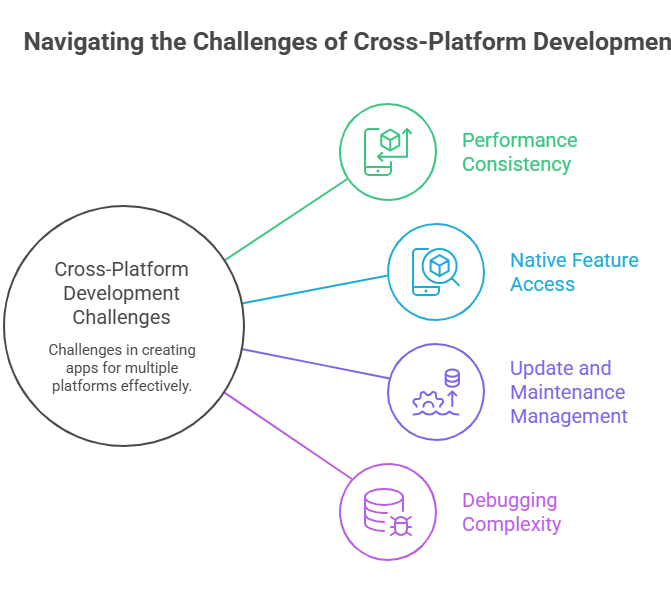
While cross-platform development is powerful, it comes with its challenges:
1. Performance Limitations
For graphics-heavy apps like AR/VR or high-end games, native development may offer better performance.
2. Limited Access to Device Features
Some advanced native features might require custom native code, increasing complexity.
3. Framework Dependency
Choosing the wrong framework can lead to compatibility issues or slower updates when platforms evolve.
4. Security Concerns
Cross-platform apps must ensure consistent security across platforms, including encryption, authentication, and data protection.
Best Practices for Building Cross-Platform Apps
1. Choose the Right Framework
Analyze your project’s requirements—UI complexity, performance needs, and developer expertise—before selecting a framework.
2. Focus on UI/UX Consistency
Even small differences between iOS and Android can affect user experience. Ensure consistent navigation, buttons, and interactions.
3. Optimize Performance
Use lazy loading, caching, and efficient API calls to maintain fast, responsive apps.
4. Test on Multiple Devices
Cross-platform apps need extensive testing on different devices and screen sizes to catch UI glitches and performance issues.
5. Keep Security in Mind
Implement secure coding practices, data encryption, and proper authentication to safeguard user data.
The Future of Cross-Platform Mobile App Development
The future of mobile app development is undoubtedly cross-platform. Here’s why:
· AI and ML integration: Cross-platform frameworks are adapting to AI/ML APIs, making apps smarter
· Web-to-mobile convergence: Progressive Web Apps (PWAs) and cross-platform frameworks are bridging gaps
· Faster innovation cycles: Businesses need apps that can adapt quickly to market changes
· IoT and wearable devices: Cross-platform development is expanding beyond phones to wearables, TVs, and smart devices
As more companies embrace digital transformation, cross-platform mobile app development will become the standard, not the exception.
Conclusion
Cross-platform mobile app development is no longer just a trend—it’s the future. By reducing development time, cutting costs, and enabling faster innovation, it empowers businesses to reach a global audience with a consistent, high-quality experience.
Frameworks like React Native, Flutter, and Xamarin are making cross-platform apps more robust, performant, and visually appealing. While there are challenges, following best practices can help businesses build apps that are secure, fast, and scalable.
In a world where users expect apps to work flawlessly on every device, businesses that embrace cross-platform development will stay ahead of the competition and thrive in the digital age.


Comments